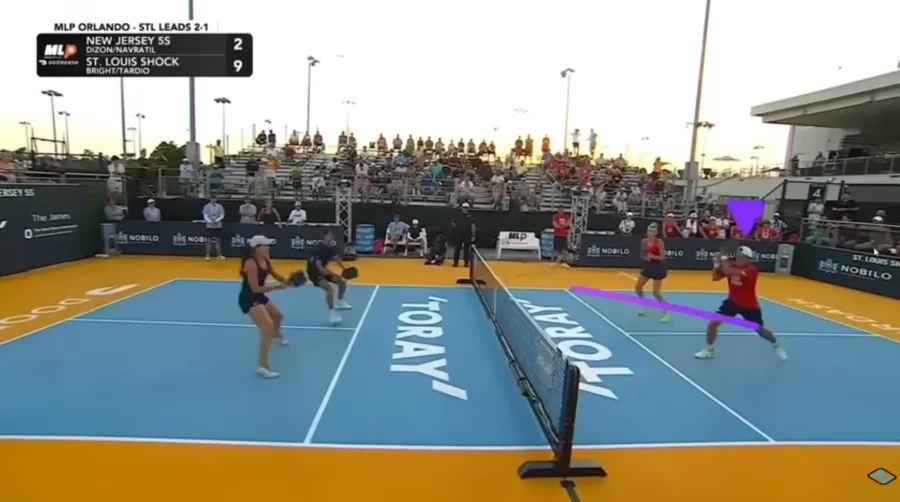
Shot selection is everything in competitive pickleball, especially at the kitchen line when points can move very fast and your reaction time is reduced to milliseconds.
Things get even more complex on the backhand side.
Thankfully, Zane Navratil has a framework he cycles through to help him rapidly analyze his options in real time and make the right decision with confidence.
He calls it the backhand decision tree. At its core, it boils down to five key questions:
✅ Should I take the ball out of the air? This should be your first instinct. First, it enables you to contact the ball at its highest point. Second, it allows you to hold your position at the kitchen line rather than being pushed back into a weaker spot.
✅ Should I attack it? Generally speaking, the higher your point of contact the better your chances for a successful attack out of the air. Anything above the knees is a good place to start.
✅ Should I let it bounce? Reaching or extending too far for a ball will impact your power and accuracy. If it feels too far, it probably is. Let these balls bounce and live to fight another round.
✅ Should I hit a one-handed backhand or two? A one-handed backhand has a wider range of motion. Use this for a defensive shot or to set up an attack. Your twoey comes with a threat of a speed-up, so it’s a more potent offensive weapon. This should be your bread and butter.
✅ Should I attack the twoey or play it safe? More and more, whenever you can hit a more offensive twoey on the backhand side, do it. This doesn’t just have to mean pace — placement is a weapon here, as well.
Obviously, time won't stand still for you to run through each of these steps before hitting every backhand during a dink exchange. But like anything, practice makes perfect.
The more you drill this sequence with intention, the more automatic it'll become.